Solving The Repair Tech Crisis
Practical Ideas to Staff Your Shop
Music retail stores do not keep the doors open with income from the repair shop. B&O Rentals do the heavy lifting. As store owners, we track all sales by product category:
Instrument sales are divided into
Guitar: acoustic or electric, sales or rentals
Keyboards: upright, grand, digital, synth, benchs, lamps
Drums: sets, hand drums, marching, sticks, mallets, hardware, heads
Pro Audio: mixing consoles, PA systems, microphones, recording
Band: flute, clarinet, sax, trumpet, trombone, reeds, mouthpieces
Orchestra: violin, viola, cello, bass, bows, cases, strings
So what profit categories do you apply to your repair shop? Or is the shop just a line item under expenses?
If you allow your shop to be nothing but an expense, not only are you missing out on some income, you’re not running your business well and instead, are intentionally losing money. In my opinion, this is not great management.
But these are the two options: your shop is an expense to B&O, or it is its own profit center. Both are logical approaches… but there’s a twist I want to point out.

If you consider your shop an expense to B&O, you should shut off the repairs to anyone else today. Fix your rentals, do the maintenance on your rental maintenance plan you sell, and don’t fix a thing for anyone else.
This is the most efficient way to operate under this P&L expectation. You will be able to reduce the number of technicians you have - they will get your rental fleet ready for you, they will be able to turn over the Maintenance Plan repairs quickly. You will reduce your payroll, and increase your rental income because every instrument you own will be rental ready.
You may suffer a bit of push back from private customers not understanding your cost efficiency. A few school teachers may question your lacking service to them, but you P&L will look better from an expense side and that hits your bottom line quickly.
The other logical way to view your shop is as a profit center with a desire to earn as much profit as possible - not gross income, profit. From a P&L standpoint, this has some positive outcomes as well, namely a tax liability benefit. If B&O pays the same rate as everyone else - which I’ll explain in a moment - the income from your largest earning department is reduced internally. The profit margin in B&O is going to be larger than in repair, so lose some of it there and reduce your tax obligation.
You will loose some of the profit from your pocket, but - as I intend to explain - you’ll be better off by not needing to attend a session called “The Repair Tech Crisis.”
I do not get involved in many online conversations about repair - I have money to make - but those I do engage in are in reaction to this phrase, “There is not money to be made in instrument repair.”
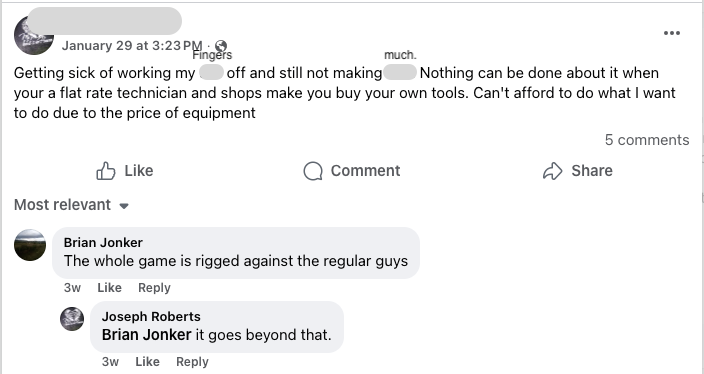
Assuming techs are difficult to find, and more than a few of them have this concern, what is your bill rate?
Here’s what I know: 14 plumber companies will have a tradesman at my toilet inside an hour. Each will charge at least $75 to show up, then at least $100/hour from there. I also know I’m the only repair tech in a very large circle around me and I have 200 instruments in my shop right now. From a simple Econ 101 standpoint, who should be charging more?
If your bill rate is not over $100 an hour… do yourself a favor and send a text to your manger right now. You’re reading this because you know the scarcity of instrument repair techs, help yourself keep those you have by allowing them a chance to earn a good living as incentive to stick around!
Another way to help techs stick around is by adjusting your price list to include as many “jobs” as possible, rather than allowing the techs to arrogantly assume they can do work faster than they can and estimate themselves out of a living.
For instance, dent work should have levels. Even if you’re going to take 1 dent out, there is a minimum charge for that every time. They came to you expecting it to be really expensive… satisfy that expectation. To help your techs conceptualize this, set your hourly rate, break that into a minute rate, and then allow for dents that take up to 14 min get billed this amount. Now allow for the next tier, and the next. Only your last (and I suggest 4) tier has an adjustable price allowed so you can adjust for the bari sax that was run over by the truck.
When estimating by the job rather than the amount of time a tech thinks the job will take, you’ve created an incentive for the tech to get better - other than stoking their ego. As they get better, they will get faster and the job will pay more.

Key Performance Indicators
As an owner, you need to help your techs make money. If you don't, they'll leave. You need to be the one setting up the system for their success and this includes developing outstanding Key Performance Indicators. These KPIs are measuring sticks to ensure your techs are doing well, know where to improve, and are motivating by allowing performance based pay.
KIP #1: Time at work and bench. You have to measure both. It is hard to measure both, I know, but it has to be done. There are software tools to help. Clock in when you show up then a simple chess timer will do the trick for bench time. However you choose to do it, you need to know how long each tech is at their bench, not just how long they are at work.
No tech can bill 8 hours a day. It’s close to impossible in a normal workday. Estimates, bathroom breaks, parts ordering, and more will get in the way of billing, and if you allow these none-profit creating tasks to grow, they will. No repair is completed by a tech who’s not at their bench, so KPI #1 is: Time At Bench.
KPI #2 for a technician is bill rate per hour worked. You need to measure and incentivize this matrix. You know how long they were working, and you know how much they billed in that time, now divide. If your tech increases this bill rate per hour, you're making more money. If you set this percent against the percent of the repair you pay your tech, this becomes a motivator to work hard.
KPI 3 is Timely Repairs. Customers come back to you when they know they can get their work done in a timely manner. If you are not measuring how long an instrument has been in the shop, I promise the length of time will increase over time and both you and your tech will earn less.
KPI #4 should be Quality of Finished Work. This applies when you have a technician whose work is being critiqued by another tech. The more they come to the senior tech asking if they are done, and are not yet done, reduces the productivity of the senior tech as well as the productivity of the Jr tech. To incentivizes them doing a better job of looking their work over before bringing it for final approval, pay them $5.00 for every instrument presented the first time that’s ready to go. I allow multiple questions along the way to help the new tech improve their skills and increase the chances of them getting the $5.00, but once they’ve presented for final approval, no more chances.
These are the basics KPIs for every repair shop.
To solve the repair crisis, first look at how you keep the techs you have, because if you can’t keep them, there is no sense bringing more on.
Shop Admin
The next step in solving the repair tech crisis is to keep the techs you have at their bench. The easiest way to accomplish this is to keep your techs at their bench by hiring a shop admin assistant. This person has one job: keep the techs at their bench. They will receive some push-back, so they too need to be motivated toward this goal. Here is the compensation needed to accomplish this:
Hourly plus commission opportunities:
- 5% of every completed repair.
- 10% of any invoice that goes past 30 days if collected by the 10th, less by the 15th, less by the 25th and so on. I want them motivated to collect cash each month.
- A monthly bonus for cumulative bench time at X so they are watching this tech KPI for you.
Their KPI’s include:
- Working Time
- Completed Repairs
- Administrative Tidiness
- Accounts Receivables (for repair invoices)
More repairs done equals more money in their pocket. Remind both the techs and your admin of their impact on the the community and the bottom line. Do this and you’ll keep the staff you have.